Tax Debt Relief and Settlement in Arizona
There is no single IRS program called debt relief. There are several tools, and the right one depends on what you owe and what you can pay. Southwest Tax Law maps them out for Arizona taxpayers.
Tax debt relief means using the IRS tools that can lower what you pay or spread it over time: an installment agreement, an offer in compromise, currently not collectible status, penalty abatement and a few related protections. Which one fits depends on your income, assets, expenses and how long the IRS has to collect.
Ads for tax settlement often promise to erase a debt for pennies on the dollar. That is not how the system works, and we say so plainly. The IRS accepts a settlement only when the numbers support it. What a good representative can do is find out which tools you qualify for, present them in the right order and keep collection from escalating while the IRS reviews your case. This page is a map of the options, with links to each detailed page.

What are my options for IRS tax debt relief?
Each tool answers a different problem, and most people use more than one over the course of a case.
Settle for less: offer in compromise
An offer in compromise lets the IRS accept less than the full balance when you cannot pay it all, based on your ability to pay. The IRS publishes an offer in compromise booklet that explains the process, and you can read the IRS offer in compromise page to see what it requires. Settlement is the choice people want most, and the one the IRS approves least casually. We run the numbers before recommending one.
Pay over time: installment agreement
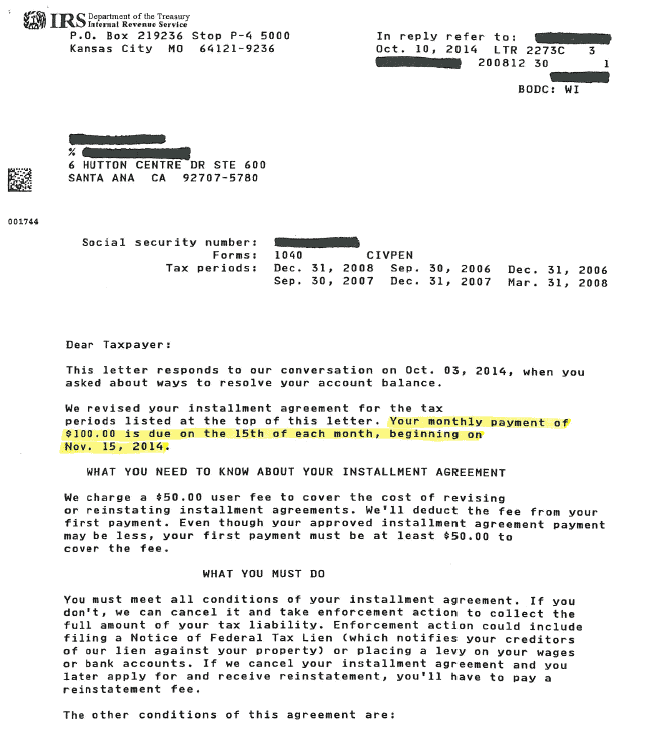
An installment agreement spreads the balance over monthly payments. The IRS lists its options on its payment plans and installment agreements page. Some plans are quick to set up. Larger balances may need a financial statement. If you cannot afford a standard monthly amount, a partial payment version may be available, discussed on the installment agreement page.
Pause collection: currently not collectible
If paying anything would leave you unable to cover basic living expenses, currently not collectible status can stop active collection for a time. Interest and penalties usually continue to build, but the pressure eases.
Reduce the bill: penalty abatement
Penalties can make up a large part of an old balance. Penalty abatement asks the IRS to remove them for reasonable cause or under first-time relief. A lower penalty total changes every option above.
Is the IRS Fresh Start program still available?
Fresh Start was a group of policy changes introduced in 2011 that made existing collection tools easier to use. It is not a standalone program you apply for. Our blog post on the IRS Fresh Start Program in Arizona explains what changed and what it means now. When someone says they can enroll you in Fresh Start, ask which tool they mean, whether it is an installment agreement, an offer or a lien withdrawal. The answer tells you what you are really buying.
How do tax settlement and negotiation work?
In practice, negotiation means you submit financial information, the IRS evaluates it against its own formulas and local expense standards, and it either accepts a resolution or tells you what is missing. Our role is to frame the facts, make sure every return is filed, remove errors from the financial statement and keep deadlines. The IRS Independent Office of Appeals reviews disagreements, which we cover on our IRS Appeals and CDP hearing page. If a collection action is causing serious hardship, the Taxpayer Advocate Service may be able to help.
What does the IRS do while I decide?
The IRS collection process escalates. After a bill comes reminders, a notice of intent to levy, and then levy action on wages or bank accounts, and it may file a federal tax lien. If you have already filed a lien, our supporting page on lien withdrawal, discharge and subordination explains your options. If you got a letter, our page on IRS notices and letters explains how to read it, and a revenue officer assignment is covered under revenue officer and collections defense.
What if the problem is bigger than the balance?
Some situations need special handling before a relief tool can be used.
- Unfiled years must be caught up first, as described on our unfiled tax returns page.
- Joint return problems may call for innocent spouse relief or injured spouse relief.
- Employers with unpaid payroll tax should read about the trust fund recovery penalty and payroll tax issues.
- Owners with business balances can start at business tax debt help.
- Old balances may be near expiration, see the collection statute page.
- Debts that may be discharged are covered under bankruptcy and tax debt.
- Disputes headed to court are handled through Tax Court representation.
- Arizona balances are covered on our page about Arizona state tax debt.
How to decide which option is right
The comparison starts with three questions. How much do you owe across all years and agencies? What can you pay each month after allowed living expenses? And how long does the IRS have left to collect? A person with a modest balance and steady income will often land on a payment plan. A person with a large balance, little income and few assets may qualify for a settlement or hardship status. A person with a closing collection window may want a different plan altogether. We build the comparison with your documents, not with a one-size pitch.
IRS rules on allowable expenses, asset values and timing change, and each case has details that move the result. That is why no responsible firm can promise a specific amount or timeline. We tell you what is realistic. Southwest Tax Law serves clients across the state, from the Tucson area to border and rural communities, and all work is handled by phone and secure portal. You can see where we serve on our locations page, read about our team, or see the full list of Arizona tax services.
If you are not sure where to start, call for a free consultation. We will ask about the notices you have received, your returns and your finances, and tell you which options are worth exploring. You can also request a callback and we will phone you.
Warning signs of a bad tax relief offer
Because the field is crowded with aggressive advertising, it helps to know what to avoid. Be careful of any company that guarantees a specific settlement amount, asks for a large payment before looking at your transcripts, tells you to stop filing returns or stop paying current taxes, or says you qualify for a program before it has seen your finances. The IRS requires current filing and payment for most relief, and a company that suggests otherwise is putting you at risk. A legitimate firm asks for your returns, your notices and your income and expenses, and tells you honestly when a settlement is not realistic. You can also check any representative through the IRS, and it never hurts to ask who will actually be working on your file. We say plainly who does the work: our team includes ex-IRS employees, enrolled agents, CPAs and licensed tax attorneys.
How long does tax debt resolution take?
It varies. A payment plan can be set up within days when the balance and income qualify. An offer in compromise can take months, and a collection appeal runs on its own schedule. During that time we handle notices and deadlines so you can focus on work and family.
Frequently asked questions
What is the best way to get IRS tax debt relief?
There is no single best way. The right choice depends on your income, assets, expenses, tax years and how much time the IRS has left to collect. Options include installment agreements, offers in compromise, hardship status and penalty abatement.
Can I settle my tax debt for pennies on the dollar?
Only if the IRS agrees that your ability to pay supports it. Settlement is available through an offer in compromise, and the IRS reviews your finances closely. We do not promise a settlement or an amount.
Is the IRS Fresh Start program a real program?
Fresh Start refers to policy changes that made existing tools easier to use. It is not a standalone program you apply for. The relief comes from tools like installment agreements and offers.
Will the IRS stop collecting while I apply?
Some applications pause certain collection actions while they are pending, but not all of them, and not automatically for every notice. We review your notices to see what protections apply.
Do I need to file all my returns before getting relief?
Generally yes. The IRS expects required returns to be filed before it considers a payment plan or settlement.
Do you help with Arizona state tax debt too?
Yes. We review Arizona Department of Revenue balances and notices, and flag state law questions for attorney review.
Ready to resolve this? As the tax attorney team Tucson and Arizona trust, we offer a free consultation with a resolution specialist, available by phone Monday through Friday. Request a callback or call (520) 900-1422.
This page is for general information and is not legal advice. Every tax matter is different, outcomes depend on the facts, and nothing here guarantees a result. Contacting Southwest Tax Law does not create an attorney-client relationship.
Other Ways We Can Help
Visit Southwest Tax Law
Get your free tax debt action plan.
15 minutes with our resolution team. A concrete plan, yours to keep. No obligation, no pressure.